Black walnut is slightly toxic for dogs
Juglans nigra L./Juglans regia L. 

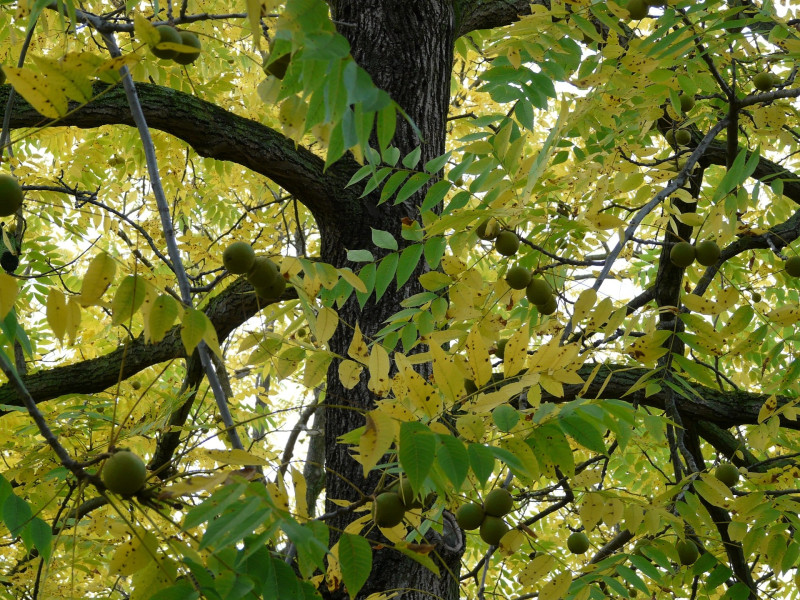
The black walnut tree belongs to the walnut family. The black walnut is not actually a tree native to Europe, as it originates from North America and Canada, but it has also been found in Europe for a long time. In Europe it grows about 20-30 metres high. The leaves are elongated and slightly serrated at the edges and about 10-20 leaves grow alternately on a stem. The flowers are long, green catkins or rather inconspicuous in female plants.
The yellow-greenish drupes are not actually nuts and are about 4-5 cm in diameter. The hard shell is difficult to crack. The green shells of the nuts and the leaves and branches contain tannins that are slightly toxic to dogs and can cause stomach and intestinal irritation.
Very toxic fungal infestation in black walnuts
But black walnuts can be attacked by a fungus that is highly toxic to dogs called Penicillium crustosum, which contains the poisonous roquefortine. Roquefortine is similarly toxic to strychnine and can lead to rapid death. Dogs die from it every year because dog owners are not aware of this danger. Therefore, you should not allow your dog to ingest black walnuts.
Shortness of breath and intestinal obstruction caused by black walnuts
Another reason why your dog should avoid black walnuts is that the black walnut shells can be sharp and can seriously injure your dog's mouth or intestines. When swallowed whole, the black walnut can get stuck in the throat or intestines. This can lead to shortness of breath or, if you are unlucky, a dangerous intestinal obstruction in dogs.
Therefore, you should make sure that your dog does not ingest black walnuts in autumn.
What should I do if my dog ate Black walnut?
How toxic is Black walnut?
| Toxicity: | (slightly toxic) |
| Toxic parts: | All parts of the black walnut tree are slightly poisonous, but especially the fruits and fruit peels can be highly poisonous if attacked by fungi. |
| Toxic time: | - |
| Antidote: | Unknown |
If your dog shows symptoms of poisoning, it is always an emergency! Time is critical for your dog's life. You should immediately call your vet or the animal emergency services and make sure that a vet is on site and then go there immediately. For the treatment, it helps the vet a lot to know what your dog has ingested.
Occurrence Black walnut
| Plant species: | tree |
| Occurrence: | Gardens, Parks, Forests |
| Areas: | Europe, North America |
| Flowering time: | summer |
| Fruit ripening: | autumn |
Symptoms
The following symptoms may occur if the dog is poisoned with the black walnut:
- irritation of the mucous membranes of the mouth due to the tannins
- cramps and trembling
- faintness
In the case of poisoning by fungi on black walnuts, the following symptoms occur:
- salivation
- nausea and vomiting
- diarrhoea
- faintness, apathy
- abdominal pain
- paralysis and movement disorders
- tremors, eye tremor, dilated pupils
- cramps
- hypothermia
- accelerated breathing
- racing heart
Treatment
The vet will always try to remove the ingested poison from the body and alleviate the specific symptoms of poisoning.
There are different methods to remove the poison from the body:
1. ACTIVATED CHARCOAL: Activated charcoal can absorb toxins. If possible, it should be administered within 2 hours after ingestion of the poison, so that the toxin does not enter the bloodstream.
2. LAXATIVES: The vet may combine the administration of activated charcoal with a laxative.
3. VOMITING: The vet can also induce vomiting using medication to remove the toxin from the body.
To alleviate the symptoms of poisoning, the vet can administer infusions and medication to protect the stomach lining.
More information on dog poisonings can be found here:
Preventing, identifying and treating poisoning in dogs
Can my dog eat nuts and seeds?
Further poisonous plants from A to Z


DigiDogs in other languages and countries DeutschlandGreat BritainUnited StatesPolska
Copyright © 2023 DigiDogs, unless otherwise noted. All rights reserved.
Über uns -
Imprint -
Privacy Policy