
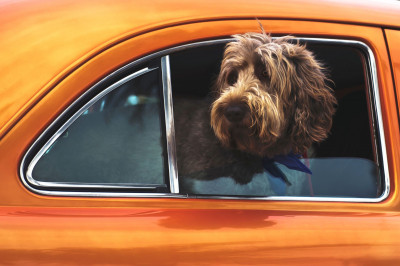
Breed Overview
53,0 - 63,0 cm
22,0 - 30,0 kg
11 - 13 years
Companion & Family Dog
Australia
Many varieties, some don’t shed
Intelligent, friendly, highly athletic & active
Top Facts
- Labrador Retriever + Poodle = Labradoodle
- Intelligent, attentive, quick to learn: need tasks
- Sporty, active, playful: need exercise
- Coat very different: not all suitable for allergy sufferers
- Love of water, love of retrieving
- Confident, intelligent, and active: this can also be exhausting
Personality
Is there such a thing as THE Labradoodle?
Labradoodles are still a very young breed, and there are many different breeding types and variations, resulting in significant differences in their personalities.
The traits of the Poodle or the Labrador may be more dominant, or they may blend into the desired optimal mix. The goal of Labradoodle breeding is to combine the positive characteristics of the Labrador Retriever and the Poodle. When successful, a Labradoodle is an active, intelligent, eager-to-learn, clever, and socially adaptable dog.
On the other hand, undesirable traits from both breeds can also become more prominent. In that case, a Labradoodle may become insecure, nervous, less people-oriented, and, in the worst case, inherit the stubbornness of some Labradors. Therefore, it’s important to choose a breeder carefully, paying attention to the temperament and health of the parent dogs.
Since Labrador Retrievers and Poodles are not fundamentally different breeds, there are also traits that apply to most Labradoodles:
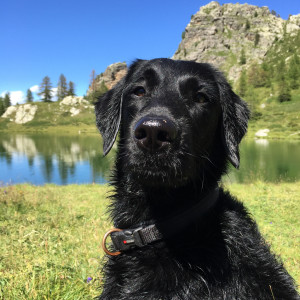
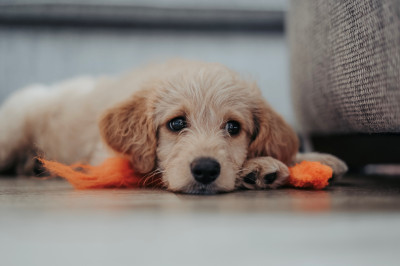
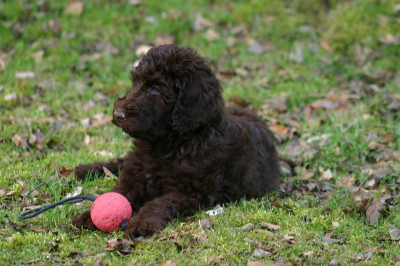
Friendly, sociable, and non-aggressive
Almost all Labradoodles have a very friendly and outgoing nature, with no aggression by default. They are naturally kind and sociable with both people and other dogs. However, Labradoodles can be cautious around strangers and may initially hold back. As with all dogs, early socialisation with everyday situations, people, animals, dogs, and, of course, children is important to prevent insecure reactions later on.
Any tendency to bark, for example, to assert themselves or when feeling uncertain, should be addressed early in training with clear boundaries.
Intelligent, attentive, and quick learners
Labradoodles are highly curious, alert, and exceptionally clever. They learn quickly, and this is where the owner needs to be consistent and quick in their reactions. Even as puppies, Labradoodles love to test their boundaries, and they require a firm but loving upbringing. "Yes means yes, and no means no" should be a rule from the start. Labradoodles respond far better to positive reinforcement and distractions than to constant prohibitions, as they are sensitive and intelligent dogs.
Sporty, active, and playful into old age
Both Labrador Retrievers and Poodles were originally working dogs bred for waterfowl hunting. As a result, Labradoodles inherit a love for physical activity, enjoy being outdoors, and particularly love playing in or around water. While they don't have to be enthusiastic swimmers, they are happy to splash around in puddles and mud.
Do Labradoodles have a hunting instinct?
These dogs can have a strong hunting instinct, especially for birds, cats, rabbits, and squirrels. Movement can be quite exciting for a Labradoodle, and they love retrieving. If you encourage this drive through activities like ball games, it can become more pronounced. However, if you prevent it, the instinct can remain manageable.
Are Labradoodles good family dogs?
Many Labradoodles are incredibly gentle and love to cuddle. They also get along well with children, playing enthusiastically with them as long as the children aren’t too young. However, especially young Labradoodles can be very lively, and if paired with the stubbornness of a Labrador, playtime can become a bit too wild for younger children.
Greedy or fussy eaters?
It depends on whether your Labradoodle takes after the Labrador side, in which case they're most likely to be a little food monster. If they take after the Poodle, they may be more particular about their food. In any case, it's important to keep an eye on your Labradoodle's weight, as excess weight can harm not just the joints but the entire body, shortening their lifespan.
Intelligence
Labradoodles are usually very smart and eager to learn. Both the clever Poodle and the loyal Labrador are working dogs at heart, known for their intelligence and quick thinking.
Attention
Labradoodles love to please, just like Poodles and Labradors. They are eager to work and learn. In rare cases, a Labradoodle may take after the more laid-back show-line Labrador, showing a calmer nature.
Exercise needs
Most Labradoodles are active and full of energy. They need plenty of exercise every day. That means at least one long walk of 1 to 1.5 hours, plus at least 2 to 3 shorter walks.
Time required
The daily time commitment is definitely something to consider, as Labradoodles need plenty of exercise. Grooming needs vary a lot depending on their coat type. Some require minimal care, while others need regular brushing and trimming.
Training
Intelligence, athleticism, and eagerness to train make Labradoodles great for many sports and activities. They love jogging, cycling, hiking, and swimming. Plus, they excel in almost every dog sport:
- Dummy training
- Food dummy training
- Scent work & tracking (search training, mantrailing)
- Hiking & jogging
- Water sports (swimming, SUP with your dog or e.g. dock diving)
- Agility
- Obedience
- Trick training
Labradoodles also do an amazing job in professional roles, such as:
- Search and rescue dogs
- Therapy dogs
- Guide dogs for the blind
- Assistance dogs
- Detection dogs
Suitable for flats
With enough mental and physical stimulation, plus good training, a Labradoodle can adapt well to apartment living. But there are two key requirements:
1. Ground-floor access or a reliable elevator
Large dogs, puppies, and young dogs are not suited for upper-floor apartments without an elevator.
- Puppies and young dogs shouldn’t climb stairs, as their bones and joints are still developing. Carrying them up and down is necessary until they’re at least one year old.
- Large breeds shouldn’t have to climb multiple flights of stairs daily due to joint stress.
- If your Labradoodle gets older or unwell, carrying them up stairs won’t always be an option.
2. Permission from your landlord or homeowner’s association
Always get written approval before keeping a dog in a rental property. If you own your apartment, check that the other homeowners in your building allow dogs.
Loyalty & friendliness
Labradoodles are incredibly loyal and devoted to their owners. They love to please and thrive on positive interactions.
Hunting drive
Labradoodles combine two breeds (Poodles and Labradors) originally bred for hunting and retrieving, especially waterfowl. Because of this, they may have a natural prey drive for birds, squirrels, or cats.
With early and consistent recall training, however, this instinct can usually be well-managed.
Staying alone
Both Labrador Retrievers and Poodles can stay home alone quite well, as long as they've learned how to do so from an early age and haven't developed any traumas.
This is also true for Labradoodles. For example, my first Labradoodle had no issues being alone and was very calm in herself, while my second Labradoodle girl Lilly started barking from a young age as soon as she had to be left alone in a room. In her case, it took much more time to slowly build up her ability to stay alone. Perhaps puppies that leave their mother later are more naturally calm in themselves.
In general, dogs should not be left alone for more than four hours at a time.
Barking
Some Labradoodles can inherit the barking tendency, or rather, the yapping of the Poodle. They might bark to alert you, assert their will, or even bark at strangers (and pretty much anything else).
Don’t worry though – this isn’t always the case, but it can happen. For example, while I thought my first Labradoodle couldn’t bark at all, my second Labradoodle started barking loudly next to me during his first meal: "Come on, hurry up!"
As Labradoodles are usually very trainable, you should be able to teach them to stop barking fairly quickly by showing them what you expect and rewarding the desired behaviour. However, this requires consistency and a bit of know-how and good timing.
Alertness
Most Labradoodles I know have an attentive alertness. Some of them are very alert and a bit nervous, but this is always very individual.
However, if the Labrador traits are stronger, the level of alertness in the Labradoodle may be lower.
Protecting
A standard Labradoodle, especially a male, can certainly be a good protector. However, due to their friendly nature, they are less suitable as guard dogs.
Dog-friendly
Labradoodles, like Labradors and Poodles, should generally be very good with other dogs. This is, of course, assuming they had a positive socialisation experience and were introduced to other dogs at an early age.
Pet-friendly
Whether Labradoodles get along with other animals depends, as with all dog breeds, on their socialisation and exposure. However, due to their natural hunting instinct, particularly towards birds, it's not uncommon for Labradoodles to show a hunting drive towards cats and small animals.
Kid-friendly
Openness to strangers
Labradoodles are usually friendly and approachable towards people who are not part of their "pack." However, they may have inherited the watchfulness and reserve of the Poodle. Depending on socialisation and breeding line, their behaviour towards strangers can vary greatly. A poorly socialised Labradoodle, especially one that has had negative experiences, may react with insecurity towards unfamiliar people.
Character & Compatibility
Health and Care
Pay attention to the health of the parents
When looking for a Labradoodle, it's important to consider the health of the parent dogs. A responsible breeder ensures that both the Labrador and the Poodle parents are healthy and free from hereditary conditions. This can help you avoid potential health issues in your future puppy. Always ask the breeder about the health history and any health checks that have been carried out on the parent dogs.
Labradoodles generally have good health. However, in Labradoodle breeding, the dogs with the best genetic traits and the most health checks are not always used, and the crossbreeding of a Labrador and a Poodle can sometimes bring health disadvantages.
Labradors, in particular, are prone to joint diseases, so it's important to ensure that the parent dogs have been tested for hip dysplasia (HD), elbow dysplasia (ED), and osteochondritis dissecans (OCD) and are free from these conditions.
Since the Labradoodle is a mix of a Labrador Retriever and a Poodle, the health issues that occur in these two breeds can also appear more frequently in the Labradoodle.
Always ask to see the health tests the parent dogs have undergone, whether via genetic testing or veterinary examination. This should always be provided in responsible breeding practices. If not, you should be cautious.
"Heterosis Effect" in Labradoodle F1
With direct breeding between a Labrador Retriever and a Poodle, there is hope for a positive effect on genetically inherited diseases. The special advantage of a hybrid (such as an F1 Labradoodle) can lie in the "heterosis effect". To simplify, this effect can lead to a higher-than-average disease resistance in the offspring, as healthy genes are often inherited dominantly. However, this does not apply to hybrid breeding with further generations, such as F2 breeding.
Robustness
Both Poodles and Labrador Retrievers, if they come from a good breeding background and are well-raised, are relatively robust and healthy dogs. This also applies to most Labradoodles.
Health Problems
When buying a Labradoodle, and especially when purchasing a Labradoodle puppy, you should pay close attention to the health of the parent dogs. Puppies almost always look adorable and healthy, but diseases in the parent dogs can become apparent in the young dog or later, leading to high costs and potential suffering.
The popularity of Labradoodles has unfortunately attracted many "breeders" who, seeing the high prices, want to make money but have no real knowledge of breeding. However, breeding should involve health checks for the parent dogs, and the desired character traits must be taken into consideration. It’s particularly important to inquire carefully about joint diseases, which can be very demanding. For example, I find it unacceptable for a dog with a B or C hip score to be used for breeding. Also, elbow dysplasia and OCD are inherited conditions that can be very problematic.
Here are some health concerns specific to Labradoodles:
-
Skin and coat problems:
Since the Poodle doesn’t shed and has constantly growing hair, while the Labrador Retriever sheds and goes through seasonal changes, Labradoodles may suffer from skin issues and itching in unfortunate cases. -
Dental issues:
The Labrador Retriever has a much broader snout than the Poodle. If a Labradoodle inherits the Labrador's teeth but the narrow snout of the Poodle, it can lead to dental malformations. -
Parent dogs often lack breeding approval:
This doesn’t necessarily mean that the parent dogs are less healthy than dogs with breeding approval, but certain tests are advantageous to give the puppies the best start.
The following conditions are more common in the Standard Poodle and, therefore, Labradoodles, compared to other dog breeds:
Some of these conditions can be tested for by breeders in the parent dogs to reduce the likelihood of them occurring in the puppies. Ask the breeder to show you what tests have been done on the parent dogs and carefully examine the results.
- Hip Dysplasia (HD) (HD test with X-ray by a specialist)
- Cataracts
- Ectopic ureters
- Sebadenitis (Genetic test)
- Tartar, poor teeth
- Gastric Torsion (Bloat)
Note: In the Miniature Poodle, which is used for the Medium Labradoodle, Patellar Luxation is more common than in other dog breeds. However, gastric torsions are less common than in the Standard Poodle.
The following conditions are rare in the Standard Poodle but still occur more frequently than in other dog breeds:
- Neonatal Encephalopathy (Genetic test)
- Von Willebrand’s Disease (Genetic test)
- Heart diseases
- Thyroid diseases
The following conditions are more common in the Labrador Retriever, and therefore Labradoodles, compared to other dog breeds:
- Elbow Dysplasia (ED)
- Hip Dysplasia (HD))
- Osteochondrosis dissecans (OCD)
- Retinal Dysplasia
- Obesity (Overweight)
Other conditions more frequently seen in the Labrador Retriever than in other dog breeds:
- Exercised Induced Collapse (EIC)
- Eye diseases such as:
- Progressive Retinal Atrophy (PRA)
This list is, of course, not exhaustive. There are unfortunately many other conditions that, while rarer, are generally more common in Labrador Retrievers than in other dog breeds. For many of these conditions, genetic tests or veterinary examinations are available and could be used by breeders.
Heat tolerance
Now it gets a bit confusing, and it really depends on the coat the Labradoodle inherits. In the end, it won’t have the Labrador Retriever’s or Poodle’s coat (hair). It’s likely to be a mix of both, especially in Labradoodle F1s. Many Labradoodles, however, don’t shed and therefore resemble the Poodle more.
Poodles can tolerate heat very well because of their coat. In hot summers, they can simply be shaved shorter and enjoy a cool bath.
Labrador Retrievers, on the other hand, come from Canada and have a dense coat. They are used to swimming in the cold Atlantic. Therefore, they don't handle heat very well and love cooling off in the water.
From personal experience, I can say that my first Labradoodle female tolerated heat well, but not as well as a Poodle. My second Labradoodle female (both F1 crosses), on the other hand, loves the cold and always seeks the coolest spots in the house, even in winter.
Cold tolerance
The ability to tolerate cold also depends on the coat/hair the Labradoodle has inherited. However, it is likely to lean more towards the Poodle:
Poodles, due to their coat and slender figure, don’t always handle the cold as well and need a longer coat in winter, as well as more exercise. During very cold winters with little exercise, it may be helpful to provide the Poodle with some warmth outside, such as a blanket. However, Standard Poodles, with proper exercise, like in dog sledding races, can handle the cold very well, even in Alaska.
Labrador Retrievers, originally from Canada, have a dense coat. As water dogs, they are accustomed to swimming in the cold Atlantic. Therefore, they cope excellently with the cold and usually need no protection during winter.
Grooming
The grooming needs of a Labradoodle largely depend on the type of coat they have inherited. While a wiry coat requires little care, wavy or even curly hair demands much more attention.
The ears, especially for breeds with floppy ears, need to be checked and cleaned regularly. It may also be necessary to remove hair from the Labradoodle’s ears to improve ventilation.
Regular grooming also includes checking and, if needed, cleaning the eyes, as well as trimming the nails.
Since Poodles are prone to tartar, dental care (whether with bones, toothbrushes, or tartar removal) should also be a part of the routine.
As wavy and curly hair often needs to be brushed and trimmed regularly, and doesn’t dry quickly after the occasional bath, the grooming effort for many Labradoodles can be higher than for other breeds. On the plus side, non-shedding Labradoodles eliminate the need for frequent vacuuming.
Bathing
Labradoodles don’t need to be bathed regularly for coat care. However, many of them love water and might even roll around in mud or carrion, making a bath necessary due to the unpleasant smell. The coat of a Labradoodle can vary greatly and may either be water-resistant or absorbent and slow to dry. If they have a Poodle-like coat, a dog hairdryer might be helpful, as it can become difficult to dry once it reaches a certain length.
Combing & Brushing
The care requirements depend on the type of coat the Labradoodle has.
The wiry coat, typical for an F1 Labradoodle but also found in multigen litters, only requires occasional brushing or combing.
On the other hand, the woolly, curly coat is the most maintenance-intensive. Regular brushing or combing is very important to avoid matting.
Shedding
Many Labradoodles, especially from later generations, do not shed. However, puppies from an F1 generation are very likely to shed, and even in later generations, this cannot be ruled out. When a Labradoodle sheds, it can shed as much as a Labrador, and that’s actually quite a lot.
Clip & Trim
It really depends on the Labradoodle and the type of coat they have. For a few Labradoodles, the coat requires little maintenance, such as those with wiry coats. However, for those with wavy or curly coats, the fur becomes very high-maintenance and needs to be regularly trimmed and clipped.
Hypoallergenic
To begin with, it should be said that there is no dog breed that is 100% hypoallergenic, meaning it doesn’t trigger allergies in humans. People are not allergic to the dog’s hair itself, but to proteins in the skin flakes or other substances that usually stick to the hair, such as sweat, oil, saliva, feces, or urine. These particles are spread through the air along with the hair and dust.
For dogs that don’t shed, like those usually found in F2 Labradoodle pairings, the likelihood of humans not having an allergic reaction is significantly higher compared to other dog breeds. Many people who are allergic to dogs experience little to no allergic reactions to non-shedding Labradoodles.
Drooling
Labradoodles generally don’t drool – unless they’re looking at a particularly tasty treat right in front of them.
Health & Care
Nutrition
Pay attention to weight and healthy teeth
The diet of a Labradoodle, like all living beings, has a huge impact on their health. A balanced and natural diet helps maintain your dog’s well-being.
What’s interesting with Labradoodles is whose appetite they inherit: While the Poodle can be quite a “picky” eater, most Labrador Retrievers are very greedy, to the point of being perpetual food machines.
So, make sure your Labradoodle gets enough food, but not too much. Labradoodles are often slimmer than Labrador Retrievers, but their hunger can be just as big.
Part of the diet should also focus on dental health: Since Poodles tend to have issues with tartar, this can also be the case with Labradoodles. With carrots or similarly hard food, tartar can naturally be worn down.
Greediness
What’s interesting with Labradoodles is whose appetite they inherit: While the Poodle can be quite a “picky” eater, most Labrador Retrievers are very greedy, or should I say, constantly hungry food machines. So, make sure your Labradoodle gets enough food but not too much. Labradoodles are often slimmer than Labrador Retrievers, but their hunger can be just as big. However, being overweight can damage their joints and significantly shorten their lifespan.
Appearance
Strong differences in the appearance of Labradoodles
Most Labradoodles do not have a truly uniform appearance, especially with direct crosses between the Labrador Retriever and the Poodle. It largely depends on whether the Labrador or the Poodle traits are more dominant. In later generations, the appearance becomes even more unpredictable in the second generation, but after that, it tends to become more uniform again.
Labradoodles come in the following three sizes:
- Standard Labradoodle: Height: 53-63 cm, Weight: 22-30 kg
- Medium Labradoodle: Height: 43-52 cm, Weight: 14-21.5 kg
- Mini Labradoodle: Height: 35-42 cm, Weight: 7-13.2 kg
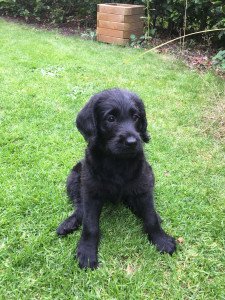
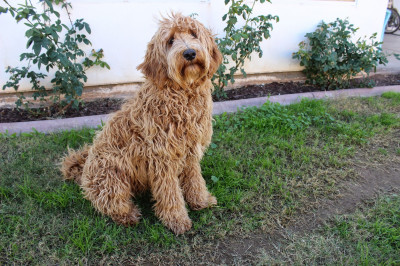
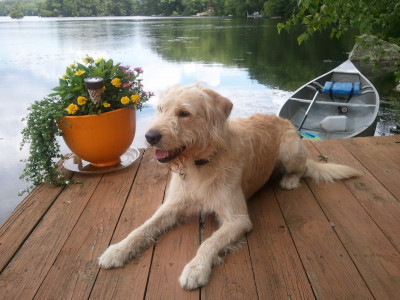
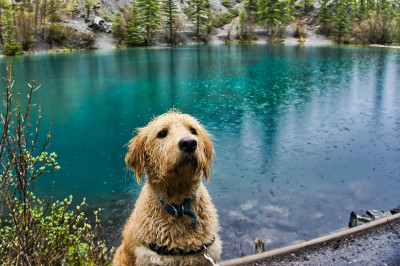
A very typical feature of Labradoodles is their often "scruffy" teddy-like coat, which can vary in length. There are three different coat types: wiry, wavy, and curly. In terms of colours, almost anything goes, ranging from white and cream to brown and black, with some even being bi-coloured.
The Labradoodle's body structure is balanced, often with long legs and a more delicate frame compared to the Labrador. The ears are floppy and well-coated, while the tail is also well-coated and set low.
Eye colour
Die Augen des Labradoodles können in Abhängigkeit zu der Fellfarbe von hellbraun bis dunkelbraun variieren.
Coat
What coat types are there for Labradoodles? How demanding is a Labradoodle's coat care?
The coat of Labradoodles varies depending on how strongly the Labrador Retriever or Poodle traits are expressed. The most common coat types (Coat Types) found in Labradoodles are as follows, but there are certainly mixed forms and various other names for Labradoodle coat types in circulation:
1. Wire-coated
This coat is most similar to the wiry coats of typical dogs like Schnauzers or some hunting breeds. This type of coat is usually relatively easy to maintain and is likely the least demanding in terms of care for Labradoodles. The wiry coat is found in F1 Labradoodles but is less common in later generations.
- The coat doesn't grow endlessly, and the dog sheds.
- Regular trimming or shaving is not necessary.
- Most likely found in F1 crosses, meaning in Standard and Medium-sized Labradoodles, but never in Mini Labradoodles.
- Weekly combing or brushing is usually sufficient.
- Trimming some areas can still be helpful for hygienic, aesthetic, or health reasons:
- Trimming hair under the paws: Long hair under the paws can mat and form knots. It’s advisable to check regularly and trim carefully.
- Trimming hair in the ears: Long and dense hair in the ears can be uncomfortable for the dog and may lead to poor ventilation and frequent ear infections. However, be cautious: if the ear hair is too short, it could cause discomfort from irritation.
- Trimming hair around the mouth: If food debris often gets stuck in the fur, trimming the hair here can be more hygienic.
- Trimming hair around the anus: The fur around the anus can mat, potentially mixing with waste, so trimming it carefully with scissors can help with hygiene.
- Trimming other areas: Any further trimming is mostly an aesthetic choice. For example, trimming the "owl eyebrows," beards, or excessively long belly fur can improve appearance.
2. Wavy-coated
The wavy coat is typically soft and moderately wavy. It is quite demanding in terms of care, but the dog is unlikely to shed.
- The coat usually grows endlessly, and the dog does not shed.
- Found in all breeding forms and generations.
- The coat must be regularly shaved or trimmed (every 6-12 weeks), often by a professional dog groomer.
- Likely found in F1 generation.
- Daily combing and brushing is required.
- If the coat gets wet or damp, it should be dried with a special dog blow dryer, as it is hard to dry naturally.
3. Curly-coated
The curly coat is soft and often tightly curled. It is very similar to the Poodle's coat. It requires a lot of maintenance but the dog does not shed.
- The coat grows endlessly, and the dog does not shed.
- Not found in F1 generation but possible in all subsequent generations.
- The coat must be regularly shaved or trimmed (every 6-12 weeks), often by a professional dog groomer.
- Daily combing and brushing is required.
- If the coat gets wet or damp, it should be dried with a special dog blow dryer, as it is difficult to dry naturally.
Coat Colour
Labradoodles come in as many colours as Labrador Retrievers and Poodles do, and the colour palette is quite large:
- White
- Yellow (from light cream to fox red)
- Apricot
- Silver
- Brown
- Black
Similar to Poodles, Labradoodles can also come in two-coloured variations, though this is less common. Examples include black-and-white or black-and-tan.
History and origin
How the cross between a Labrador retriever and a poodle came to be
FCI-Classification
No. 0
Origin
Australia
History
A young history: The Labradoodle was created around 1989
The history of the Labradoodle is relatively recent, starting in Australia. Wally Conron, the head of breeders at the Australian Guide Dog Association, coined the name "Labradoodle" in 1989 after crossbreeding a Labrador Retriever with a Standard Poodle.
The search for an allergy-friendly guide dog
Pat Blum, who had suffered from severe vision problems and was nearly blind but could never have a guide dog due to her husband's dog allergies, contacted the Australian Guide Dog Association. Australia was a practical choice as dogs from there could be flown directly to Hawaii without quarantine. Pat Blum was the reason Wally Conron decided to breed a dog that would be as suitable for a guide dog as a Labrador Retriever but wouldn't trigger allergies, like the hypoallergenic Poodle.
Direct breeding of Poodles and Labradors resulted in an allergy-free puppy
From the first breeding, three puppies were born (named Simon, Sheik, and Sultan), and fur samples were sent to Hawaii. Only Sultan's coat didn’t trigger any allergies in Pat's husband. As a result, Sultan was trained as a guide dog and handed over to Pat Blum when he was 18 months old.
Thus began the breeding of guide dogs aimed at being hypoallergenic and non-shedding. Almost all of the first-generation crosses were excellent as guide dogs, though only about 30% were hypoallergenic.
The hybrid and designer dog boom
The first Labradoodles triggered a near-global boom in so-called hybrid and designer dogs, particularly in Australia, the USA, and Europe.
Australian Labradoodles – breeding efforts and recognition of the breed
Labradoodles became popular not just in Hawaii but also as family dogs due to their growing popularity.
Breeding across multiple generations began
In the following years, Labradoodles were bred in multiple generations in Australia (not just as a mix of Labrador and Poodle) and mixed with other breeds to establish a new breed. In the 1990s, breeders of Cocker Spaniels and Poodles (now called Cockapoos, or Spoodles in Australia) started crossbreeding Labradoodles with Labradoodles or Poodles with Labradoodles, aiming to breed dogs that wouldn’t shed, wouldn’t cause allergies, and would retain the friendly nature of Labradoodles.
Later, other breeds like Curly-Coated Retrievers, Irish Water Spaniels, and Cocker Spaniels (both English and American Cocker Spaniels) were also incorporated into the breeding.
Labradoodles become popular in the USA – associations formed – Australian Labradoodle recognised
By the late 1990s, these dog breeds became known and widely popular in the USA, and Labradoodle associations were formed in Australia. In June 2000, the Labradoodle Association of Australia (LAA) was founded, always with the goal of having the Labradoodle officially recognised by the Australian National Kennel Club (ANKC). The LAA changed its name to the Australian Labradoodle Association (ALA) in 2005.
In 2004, the International Labradoodle Association (ILA) was founded. In 2005, the International Australian Labradoodle Association (IALA) was established as a global body for Labradoodle breeding, merging the two previous associations. It is now known as the Worldwide Australian Labradoodle Association (WALA). The goal, according to the association, is to establish a breed standard with health tests and a stringent breeding programme to gain recognition. In Europe, there is the Australian Labradoodle Association Europe (ALAEU).
The "Australian Labradoodle" has been recognised as a breed by the US Continental Kennel Club. The ALAA (Australian Labradoodle Association of America) and the Australian Labradoodle Club of America (ALCA) are the main associations in the USA.
Australian Cobberdog – another Labradoodle?
The Australian Cobberdog claims to be the one true Labradoodle. It is certain that Labradoodles have been bred over multiple generations and crossed with the Irish Soft-Coated Wheaten Terrier. The goal was to have the breed officially recognised and establish breeding standards. The breed has been recognised by the MDBA (Master Dog Breeders & Associates).
"Just say no to designer dogs" – why breeder associations often oppose designer dogs
In the USA, many breeder associations of both Poodles and Labrador Retrievers have made statements against designer dogs, including Labradoodles.
The following arguments are often made by breed clubs and associations like "The Poodle Club of America" or "The Labrador Club" against designer dogs:
- It’s illogical to believe that mixes of other breeds with Poodles will combine the best traits of both breeds. Designer dog puppies can inherit the worst traits from both parents, and "breeders" have little control over the outcome.
- Designer dogs, especially those with Poodles, are often marketed as hypoallergenic, non-shedding, friendly family dogs, and highly intelligent. However, this is not always the case.
- Designer dogs are overpriced.
- The parent dogs of designer dogs are often subjected to few or no health tests.
- There is no predictability regarding size, shape, coat, colour, or character traits in designer dogs.
- Dogs used for breeding designer dogs are often excluded from breeding associations, meaning dogs with poorer health and character qualities are used, or those not officially allowed for breeding.
- Despite these arguments, it’s clear that breeding associations are reluctant to see more competition from hybrid dogs, and they question the cost-benefit of some hybrid breeders. However, new breeds have always been created in the history of dog breeding through the crossbreeding of old breeds.
Despite these arguments, it’s clear that breeding associations are reluctant to see more competition from hybrid dogs, and they question the cost-benefit of some hybrid breeders. However, new breeds have always been created in the history of dog breeding through the crossbreeding of old breeds.
Labradoodle summary
Friendly, Intelligent, and Athletic Companions
A Labradoodle that has had the opportunity to learn good manners and is both physically and mentally stimulated is a fantastic family and companion dog. Labradoodles are usually friendly and social, but they can also be spirited and occasionally stubborn. If they have inherited the Poodle’s coat, they won’t shed – but regular grooming is necessary.
DigiDogs in other languages and countries DeutschlandGreat BritainUnited StatesPolska
Copyright © 2023 DigiDogs, unless otherwise noted. All rights reserved.
Über uns -
Imprint -
Privacy Policy